The bracket operators defined earlier allow constructions of algebras assigned to specific verses. Verse 2:282 will be selected to serve as the example where a sequence of algebras are assigned to its ALM linear content (LC). This verse which clarifies matters regarding general financial transactions is unique on several accounts. It is the longest verse with the highest number of the initialed letters A, L and M. The word God (ALLE) appears six times, (the second highest), exclusively in this verse.
Previously, chapter two was given a pair of left/right LC algebras,
themselves derived from their corresponding left/right (co)bif-2 algebras
with basis consisting of the tetron along with the first and last verses:
2:{0, 1, 286}. Verse 2:282 is represented by its corresponding left/right
versors:
LV = (3832, 12073, 220)
RV = (4318, 888,
8117)
in component form. In fully expanded form in terms of the
basis verses, they are:
LV = 3832 (2:0) + 12073 (2:1) + 220
(2:286)
RV = 4318 (2:0) + 888 (2:1) + 8117 (2:286)
The versors
in turn acquire their LCs via the special linear map Q that was
constructed previously. It was the isomorphism between the (co)bif-2 and
the LC algebras over the same ground field F12697. It assigned to versors
their LCs in the standard basis {A, L, M}:
.
Let LLC and RLC be the left/right external LCs, (XLCs),
obtained via Q:
LLC = Q LV = (8735, 7287, 595)
RLC = Q RV = (9851, 9816, 1553),
where, on the right-hand-side Q acts on versors LV and RV via
matrix-vector multiplication. The XLCs in component form are:
LLC = 8735 A + 7287 L + 595 M
RLC = 9851 A + 9816 L + 1553 M
The internal LC of 2:282 is: ILC = 107 A + 66 L + 31 M = (107, 66, 31).
These are the literal occurrences of the ALM letters within the textual
composition of the verse.
In order to apply the bracket operators defined previously, a bracket basis (BK) will be defined in the LC algebras. The actions of the bracket operators will then lead to construction of specialized algebras specifically tailored to a given verse. The BK will be defined within the context of the ALM content of the tetron.
Let k-word be a word of length k for k > 0. The word-delimited ALM content in the tetron consists of ten letters. They are divided into four words: one 1-word and three 3-words. They take the following two forms: M ALL ALM ALM, (left-to-right as in English), and MLA MLA LLA M, (right-to-left as in Arabic). Since, the multiplication in the LC algebra is not associative, bracketing is necessary when there are more than two operands. There are 4862 (Catalan number C10) ways to parenthesize the product of ten elements. However, only a small subset of those will be chosen that would respect the word boundaries. Subsequently, each ALM-word is parenthesized individually: M (ALL) (ALM) (ALM) for left-to-right and (MLA) (MLA) (LLA) M for right-to-left. Note that the 1-word M does not require bracketing. The 3-words will further be parenthesized based on the adjacency of their letters.
In the left-to-right case, the three letters A, L, and L come from the tetron-word ALLE. They are all adjacent and hence can be bracketed in two ways: (AL)L and A(LL). In contrast, the letters A, L, and M from tetron-words ALRHMN and ALRHJM are not altogether adjacent: while A and L are adjacent, letter M is separated with non-ALM intertwining letters (RH and RHJ, respectively). The adjacent letters are bracketed together leading to the only possible parenthesization: (AL)M. Similarly, in the right-to-left case, the admissible bracketings are the symmetric mirrors (LL)A, L(LA) and M(LA).
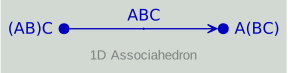
An arbitrary 3-word ABC can be parenthesized in two ways: (AB)C and A(BC). The second form can be obtained from the first simply by shifting the parentheses to the right via one associativity move. This left-to-right movement of parentheses can be interpreted as a form of ordering where the right side is considered greater than the left side: (AB)C < A(BC). This relationship between the two bracketings can be represented geometrically via an arrow where the direction of the arrow indicates the "greater than" ordering:
This ordering can readily be applied to longer products. As was noted previously, the products of four elements can be parenthesized in five ways (C4 = 5): ((AB)C)D, (A(BC))D, (AB)(CD), A((BC)D), A(B(CD)). Geometrically, they can be displayed as vertices of a pentagon with directed edges:
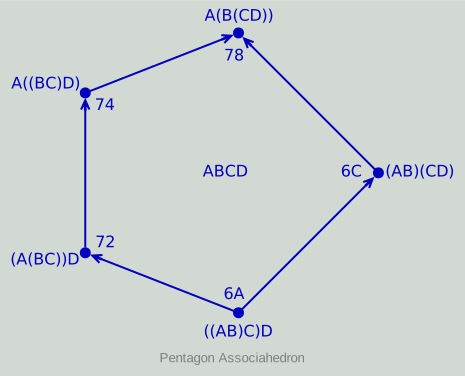
The corresponding hexadecimal postfix representations (without the leading 0X) of the brackets are displayed inside the pentagon. Each directed edge connects a pair of comparable bracketings where the "greater than" relationship follows in the direction of the arrow; bracketing at the head of the arrow is greater than the one at the tail. The parentheses shift to the right from the bottom to the top. The minimum is the one with all the parentheses on the left, while its mirror (the maximum) at the top has all parentheses shifted to the right. Between the two extremes there are the intermediate bracketings at various stages. Any pair of vertices that can be connected via a directed path (along a chain of arrows) are comparable. If no such path exists then the two are not comparable. In particular, the rightmost vertex (AB)(CD) is not comparable with the two leftmost vertices (A(BC))D and A((BC)D) since there is no directed path along the arrows starting from one side to the opposite side. This implies that the rightmost vertex is neither greater nor smaller than the two leftmost vertices. This is an example of a partial ordering where not every pair of elements can be compared. This is in contrast to total ordering where any two elements can be compared: either X < Y or X > Y, like familiar numbers. A set whose elements are equipped with such a partial ordering is called a partially ordered set or poset.
Similarly, the 14 ways of parenthesizations of five elements (C5 = 14) form the vertices of a three dimensional geometric polyhedron whose directed edges connect pairs of bracketings with the "greater than" relationship. These geometric representations and their higher dimensional analogs are collectively known as associahedrons. Their directed edges and vertices represent the partial orderings among the Catalan number of bracketings based on associativity rules.
The products of the ten ALM-letters in the tetron as per above were restricted only to the admissible bracketings to conform with the word boundaries. This resulted in a significant reduction in the number of parenthesizations. The final expression involved the products of four words with their bracketings forming a pentagon. However, the 3-word (ALL) is parenthesized in two ways, (AL)L and A(LL), (also denoted by AL.L and A.LL, for simplicity), leading to two such pentagons containing one of each.
In the left-to-right case, the expression, M (ALL) (AL.M) (AL.M),
acquires the following pentagons:
Vertices with ALL parenthesized as A.LL:
((M(A.LL))(AL.M))(AL.M)
(M((A.LL)(AL.M)))(AL.M)
(M(A.LL))((AL.M)(AL.M))
M(((A.LL)(AL.M))(AL.M))
M((A.LL)((AL.M)(AL.M)))
Vertices with ALL parenthesized as AL.L:
((M(AL.L))(AL.M))(AL.M)
(M((AL.L)(AL.M)))(AL.M)
(M(AL.L))((AL.M)(AL.M))
M(((AL.L)(AL.M))(AL.M))
M((AL.L)((AL.M)(AL.M)))
Geometrically, the pair of pentagons can form the top and bottom faces of
a prism whose bottom-to-top directed vertical edges connect corresponding
pairs of identical bracketings which differ only in the parenthesization
of (ALL): AL.L at the bottom and A.LL at the top. Since, they are similar
to associators they will be referred to as the vertical associators.
Similarly, in the right-to-left case, the product (MLA) (MLA) (LLA) M
acquires its corresponding prism:
Vertices of the top pentagon with LLA parenthesized as L.LA:
(((M.LA)(M.LA))(L.LA))M
((M.LA)((M.LA)(L.LA)))M
((M.LA)(M.LA))((L.LA)M)
(M.LA)(((M.LA)(L.LA))M)
(M.LA)((M.LA)((L.LA)M))
Vertices of the bottom pentagon with LLA parenthesized as LL.A:
(((M.LA)(M.LA))(LL.A))M
((M.LA)((M.LA)(LL.A)))M
((M.LA)(M.LA))((LL.A)M)
(M.LA)(((M.LA)(LL.A))M)
(M.LA)((M.LA)((LL.A)M))
The vertical edges (associators) then connect pairs of identical
bracketings from the bottom pentagon to the top which differ only in
LL.A at the bottom and L.LA at the top.
Three vertical associators will be chosen to form the bracket basis. It
includes the two leftmost and the rightmost vertical edges. Recall, the
associator on an edge is the difference between its end-points:
bottom-vertex − top-vertex:
Left-to-right:
(M((AL.L)(AL.M)))(AL.M) − (M((A.LL)(AL.M)))(AL.M)
(M(AL.L))((AL.M)(AL.M)) − (M(A.LL))((AL.M)(AL.M))
M(((AL.L)(AL.M))(AL.M)) − M(((A.LL)(AL.M))(AL.M))
Right-to-left:
((M.LA)((M.LA)(LL.A)))M − ((M.LA)((M.LA)(L.LA)))M
((M.LA)(M.LA))((LL.A)M) − ((M.LA)(M.LA))((L.LA)M)
(M.LA)(((M.LA)(LL.A))M) − (M.LA)(((M.LA)(L.LA))M)
The bracketings in postfix notation, respectively are: 0X72, 0X6C, 0X74.
The bracket basis enables the linear bracket operators defined previously to operate on arbitrary LCs. Their actions on the ILCs and XLCs of verses allow constructions of algebras specific to given verses.