A proper framework is a necessary prerequisite to facilitate arithmetic and algebraic operations. At the lowest level, a suitable underlying set is to be chosen to serve as the foundation for subsequent developments. The set is then equipped with a collections of operations, such as additions and multiplications, of various arities (binary, ternary, etc.) subject to some appropriately chosen axioms. The following is a quick introduction to some basic terminologies and concepts that may prove useful in the sequel. At the bottom of the hierarchy, is the notion of a set. Intuitively, a set is simply a collections of objects devoid from any further structures. A binary operation on a set is a rule to combine any two elements in the set producing a third element. A ternary operation combines three elements from the set and produces another element within the set. Higher arities are defined, similarly. In the opposite direction a unary operation is simply a function taking an element of the set and mapping it into another. The nullary operation is a function that takes no element (zero arity) and returns a fixed element. It is equivalent to selecting a distinguished element in the set. In general, an arbitrary number of operations can be defined on a given underlying set.
A set equipped with a single binary operations is called a magma. The operation is arbitrary and is not required to satisfy any specific property. If the operation (generally called multiplication) is associative: (ab)c = a(bc), it is called a semigroup. Additionally, if there exists a neutral element, e, such that ea = ae = a, for all a, it is a monoid. If every element, a, in the monoid has an inverse, a−1, such that aa−1 = a−1a = e, it is called a group. Lastly, if the operation in the group is commutative, ab = ba, it is an abelian group. The set of integers ℤ = {... , −2, −1, 0, 1, 2, ...} forms a commutative monoid under multiplication and an abelian group under addition. zero and one are the respective neutral elements under addition and multiplication.
In the above descriptions a sequence of structures were obtained starting at the lowest level, the underlying set, followed by successively imposing additional properties at each stage. However, they were all limited to a single binary operation. More elaborate structures may be obtained via addition of a second operation. A ring is an additive abelian group (with addition as the binary operation) augmented with a second binary operation, called multiplication, under which it forms a monoid. Interaction between the two operations is achieved via multiplication being distributive over addition on both sides: a(b + c) = ab + ac and (a + b)c = ac + bc. The multiplication is not required to be commutative: ab ≠ ba. If it is, it is called a commutative ring. A field is a commutative ring where the non-zero elements have multiplicative inverses. The set of integers ℤ is the canonical example of a commutative ring.
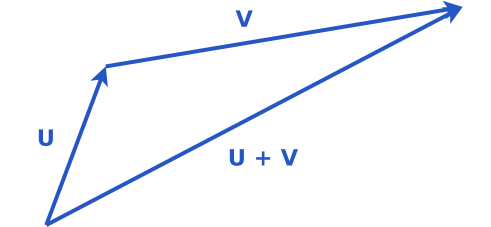
The elements in an additive abelian group can also be allowed to be acted upon by elements from other sets. In particular, they can be scaled by elements of a field (scalar multiplication) to form a vector space. The scalar multiplication is subject to the usual associativity and distributivity. The elements in a vector space are called vectors. Geometrically, a vector can be viewed as an arrow with a given length and direction. The sum of two vectors U and V is obtained by first moving along U then continuing along V. The order is immaterial. Geometrically, if the tail of V is at the head of U, the sum is a vector beginning at the tail of U and ending at the head of V as illustrated below. The multiplication of a vector by a scalar simply scales the length of the vector. Multiplication by a negative number reverses its direction. In general, the vectors can be abstract and are not required to be of geometric origin.
As an example of a vector space, consider the real line extending in both directions. The vectors have their tails at the origin and are multiple of the unit vector with the head located at 1. All vectors are scalar multiples of the sole unit vector. This is an example of a one dimensional space. In higher dimensional vector spaces, all vectors can be expressed uniquely as sums of scalar multiples of a selected minimal set of vectors, called, a basis whose number of elements is the dimension of the vector space. As an example of a two dimensional space, consider the XY-plane. The two unit vectors along the X and Y axes, (1, 0) and (0, 1), form the standard basis spanning the space: all vectors are expressed uniquely as the sums of the scalar multiples (also called linear combination) of the two basis vectors: (a, b) = a (1, 0) + b (0, 1). Similarly, in three dimensions, the set of unit vectors along the X, Y, and Z axes {(1, 0, 0), (0, 1, 0), (0, 0, 1)} forms the standard basis. An arbitrary vector (a, b, c) can be uniquely expressed as a linear combination of the basis vectors: (a, b, c) = a (1, 0, 0) + b (0, 1, 0) + c (0, 0, 1). This can be readily generalized to higher dimensional vector spaces.
Vector spaces can be further generalized to modules by allowing the scalars to come from an arbitrary ring instead of a field. As cited above rings are not in general commutative and their elements are not required to have multiplicative inverses. Fields are simply a special type of rings. A module over a ring R is called an R-module. The polynomials in one indeterminate with integer coefficients is an example of a commutative module. If the ring R is noncommutative, the scalar multiplication from left and right will result in distinct left and right R-modules.
An algebra is a vector space equipped with multiplication between vectors. The products of vectors distributes over addition. In a more general setting, an algebra can be defined over a module. The multiplication in an algebra need not be associative. In a unital algebra there is a multiplicative neutral element, 𝟙, such that 𝟙 a = a 𝟙 = a, for an arbitrary element a in the algebra.
A function f between two sets from A to B, f: A ⟶ B, maps elements of the domain A to codomain B. If distinct elements are mapped to distinct elements the function is one-to-one or injective: for x and y in A and x ≠ y, f(x) ≠ f(y). If every element of B is an image of some element in A, the function is onto or surjective: for arbitrary b ∈ B, there is an a ∈ A such that f(a) = b. if it is both injective and surjective, it is bijective. If the function is between sets equipped with algebraic structures such as groups, rings, or algebras, the function is required to preserve the algebraic structures. Such a special functions is called a morphism. For instance, if A and B are (multiplicative) groups, then f is a group morphism if f(xy) = f(x)f(y), for all x and y in A. This means it is the same whether x and y are first multiplied in A then mapped to B or each mapped to B first then multiplied in B. Both methods give the same result. In rings, morphisms preserve both additions and multiplications: f(x + y) = f(x) + f(y). In unital algebras morphisms are required to map the unit in the domain to the unit in the codomain. An injective morphism is also called a monomorphism and a surjective morphism is epimorphism. If it is both then it is an isomorphism. A morphism from an algebraic object (groups, rings, etc.) to itself is an endomorphism. An isomorphism from an object to itself is called an automorphism. Morphisms are of great significance since they allow comparisons among algebraic structures or to embed one structure within another. Commonly, the word map is also used as a synonym for morphism. A map between sets is simply a set function.